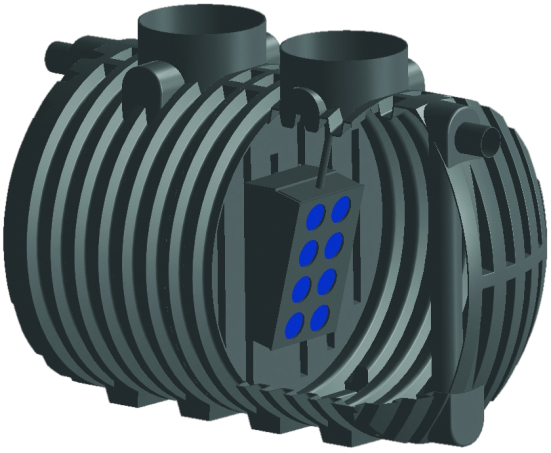
Die Auswahl des geeigneten Ölabscheiders muss auf einer detaillierten Analyse des Aufstellungsortes basieren, da die Projektbedingungen die Dimensionierung und Konfiguration des Systems direkt beeinflussen. Nur ein ordnungsgemäß ausgewählter und dimensionierter Abscheider gewährleistet eine optimale Öltrennung und die Einhaltung der geltenden Vorschriften.
Ein wichtiger Bestandteil von Ölabscheidern ist der Schlammfang (Sedimentationskammer). Dies ist der Teil der Anlage, in dem sich Feststoffe (Sand, Schlamm und größere Ablagerungen) am Boden absetzen, bevor das ölhaltige Wasser in die weiteren Reinigungsstufen geleitet wird.
Die folgende Tabelle zeigt das Mindestvolumen des Schlammfangs in Abhängigkeit vom Einbauort. Die Daten basieren auf der Norm SIST EN 858.
WICHTIG: Die entsprechende Kategorie des Ölabscheiders wird vom Planer festgelegt. Das Schlammfangvolumen muss gemäß der untenstehenden Tabelle definiert werden.
| Kategorie |
Anwendung des Ölabscheiders |
Mindestvolumen des Schlammfangs |
| Gering |
Für Wasser mit geringem Sedimentgehalt – z. B. Auffangflächen an Tankstellen, leicht belastete Parkflächen |
(100 × NS) / fd a |
| Mittel |
Tankstellen, manuelle Waschanlagen, Garagen, Parkflächen, Industrieanlagen, Kraftwerke |
(200 × NS) / fd b |
| Hoch |
Lkw-Waschanlagen, Stadtbusse, landwirtschaftliche Fahrzeuge, automatische Waschanlagen |
(300 × NS) / fd b
(300 × NS) / fd c |
Anmerkungen:
a – die Gleichung gilt nicht für Abscheider kleiner als NS 10, außer für überdachte Parkflächen.
b – unabhängig von der Gleichung darf das Mindestvolumen des Schlammfangs nicht weniger als 600 l betragen.
c – unabhängig von der Gleichung darf das Mindestvolumen des Schlammfangs nicht weniger als 5000 l betragen.